
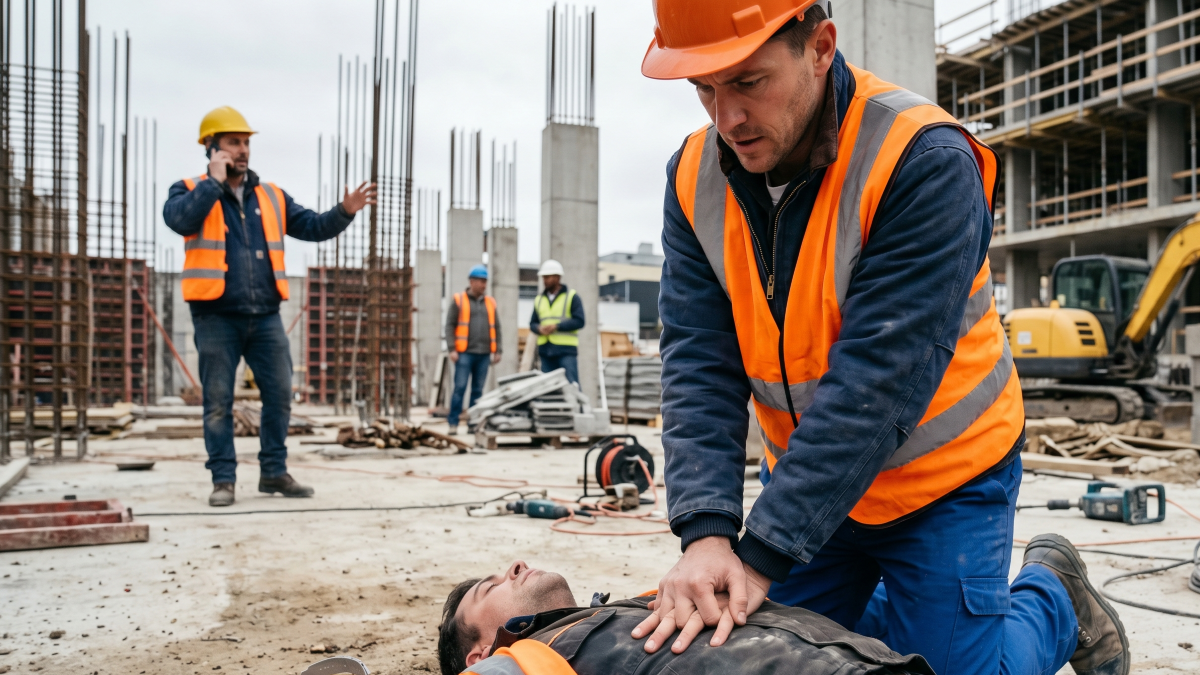
It's 2:15 on a Tuesday afternoon. A concrete pour is running ahead of schedule, the safety briefing went smoothly this morning, and the crew is working in rhythm. Then a foreman clutches his chest and drops to the ground. What happens in the next four minutes will determine whether he goes home to his family.
Sudden cardiac arrest strikes more than 350,000 Americans outside of a hospital each year, and a significant share of those events happen at work. The importance of CPR (cardiopulmonary resuscitation) in these moments can't be overstated; it is the single most decisive factor between a near-miss and a tragedy. For someone in cardiac arrest, every minute without CPR reduces their chance of survival by 7 to 10 percent.
That gap between collapse and professional response is where outcomes are decided, and this is what Mobile Medical Corporation has spent 35+ years helping employers close - not with paperwork, but with trained individuals ready to act the moment it matters.
The Science of the "Golden Window": How Effective is CPR?
When the heart stops, everything is on a timer. The moment the heart ceases pumping, oxygenated blood stops circulating. The brain, which consumes roughly 20 percent of the body's oxygen supply, is the first organ to feel it. After 4 minutes without blood flow, brain cells begin to die. By 10 minutes, the damage is often irreversible.
Survival depends on a concept the American Heart Association calls the Chain of Survival, a sequence of actions that each buys critical time for the next:
1 - Recognition: Someone sees the emergency and acts instead of freezing.
2 - Call to 911: Professional help is dispatched.
3 - CPR: Compressions begin immediately to maintain blood flow.
4 - Defibrillation: An automated external defibrillator (AED) delivers a shock to restore the heart rhythm.
5 - Advanced Care: EMS or on-site medical professionals take over with advanced interventions.
Every link matters, but the effectiveness of CPR depends entirely on someone being ready (and willing) to start the chain.
The good news is that effective CPR doesn't require a medical degree. Hands-only CPR (steady chest compressions at 100 to 120 beats per minute) works as a manual pump, forcing blood from the heart to the brain and vital organs. Throughout this process, the brain is kept viable until medical personnel or an on-site team of trained responders can deliver definitive care.
Why On-Site CPR Training Is a Strategic Business Asset
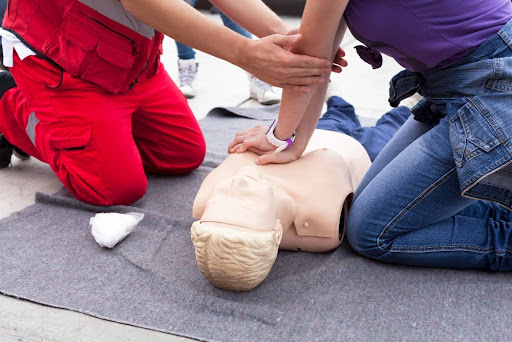
Most organizations treat CPR training as a line item in their compliance budget, something to schedule, document, and file away. But the companies that recognize the importance of CPR understand that a trained workforce goes beyond a regulatory checkbox. Rather, it's a layer of operational resilience that protects people, reputation, and the bottom line simultaneously.
Minimizing Liability
When a cardiac emergency happens on-site, and no one is equipped to respond, the consequences extend well beyond the medical outcome. Wrongful death litigation, increased insurance premiums, project shutdowns - the financial and legal exposure from a single preventable death may follow an organization for years.
A workforce trained in CPR and early defibrillation doesn't eliminate risk, but it dramatically reduces the likelihood of the worst-case scenario becoming a reality.
Empowering Your Workforce
There's a less quantifiable but equally real return on training: trust. When employees know the person working next to them can keep them alive in an emergency, it changes the way they feel about the organization that made such reassurance possible.
CPR training signals that a company values its people beyond their productivity, and that kind of culture improves morale as well as retention.
The Mobile Medical Advantage: Expert-Led Preparedness
Knowing CPR matters. But knowing it well - confidently, under pressure, with the muscle memory to act - requires more than a laminated card.
With decades of experience in occupational health and on-site medical services, MMC doesn't teach CPR from only a textbook. Our instructors draw from real-world medical expertise across high-risk industries, from construction environments to manufacturing floors.
Beyond the Classroom
Training is just one piece of the equation. MMC also provides the infrastructure that makes a trained response effective, including supplying and maintaining AED units, ensuring equipment is accessible, and helping organizations build an emergency action plan that accounts for their specific risks. When every second counts, having the right equipment in the right place matters as much as having the critical knowledge.
On-Site Trained Professionals
MMC proudly offers what most safety providers can't: certified medical professionals embedded directly on-site. Through our on-site clinics, we put trained responders where emergencies actually happen.
This means the CPR success rate on your site isn't dependent on which employees remembered their training. Instead, it's backed by professionals whose full-time job is keeping your people safe.
Scaled to Fit
A 12-person office and a 2,000-worker pipeline project don't need the same medical footprint, and we don't pretend they do. From single-site training sessions to full medical staffing programs, our services are custom-built around the size, risk profile, and operational demands of every client we serve.
Make Safety Non-Negotiable with MMC
CPR training is a foundational piece of risk management that allows leadership to focus on growth, operations, and long-term strategy with the confidence that their most valuable assets - their people - are genuinely protected. Not on paper, but in practice.
Don't wait for an emergency to realize you aren't prepared. Secure your job site and empower your team with industry-leading CPR training and on-site medical services.